
The arm that froze on Sundays.
Carla has the technique. Tactically, she does the right things. Physically, she's well prepared. Any coach who saw her train on a Monday would say she's ready.
But Carla didn't play on Mondays. She played on Sundays. And on Sundays, when the score reached 5-4 or the closing game, her arm froze. She wasn't failing for lack of technique: she was missing the easiest ball of the match, in the moment when she needed it most.
At JF2 Academy, we know this is no coincidence. It has a clinical name: choking under pressure. And, for the first time in padel, it also has a metric.
The science behind the block.
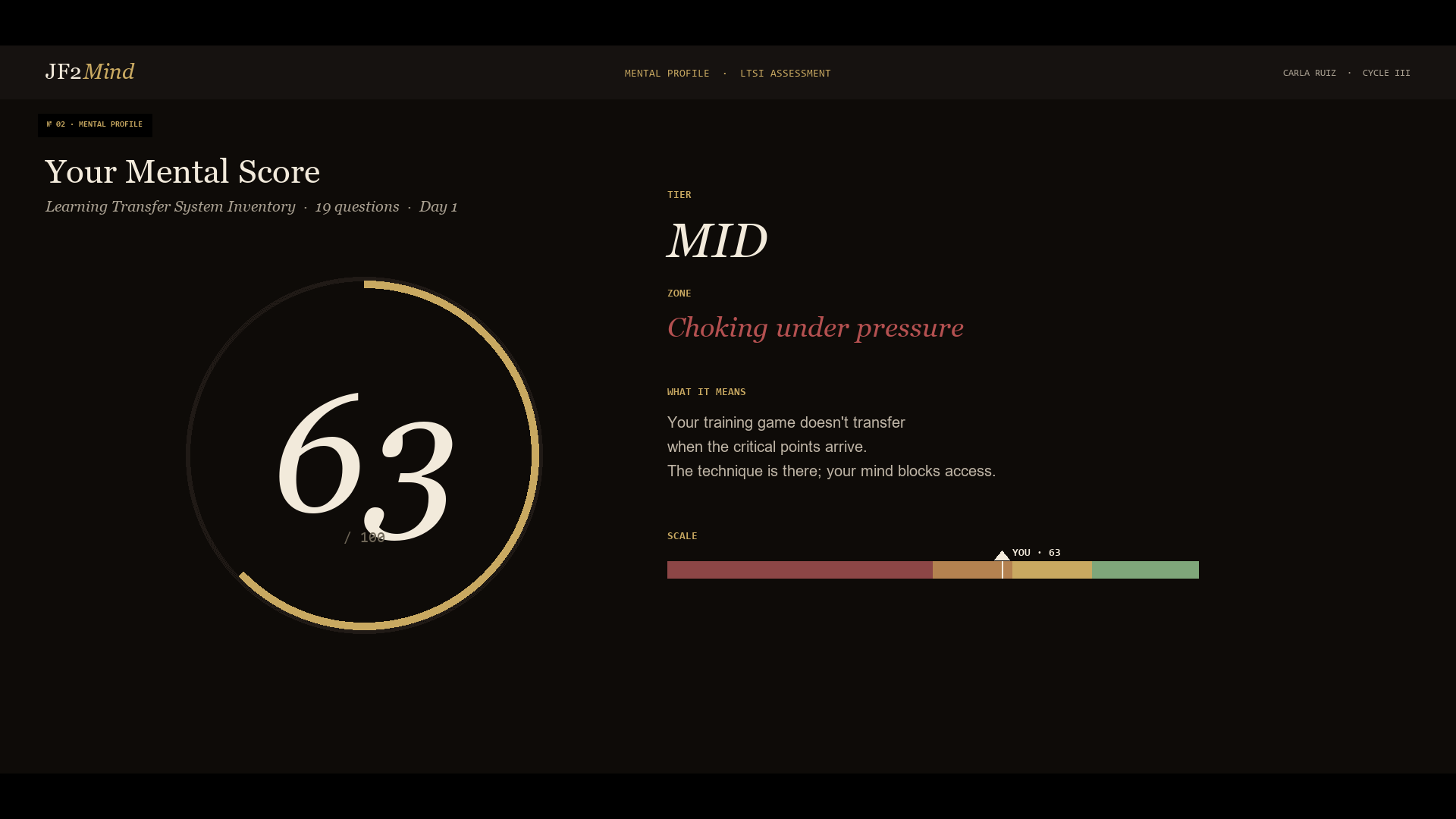
On day one, Carla didn't get a motivational speech. She got a scientific questionnaire: the LTSI (Learning Transfer System Inventory), the academic standard instrument to measure whether what you train transfers to the match — adapted to padel within the JF2 Mind system.

Carla's coach in cycle III of JF2 Mind. His job isn't only to teach and train the technical, tactical and physical pillars on court: his job is to be a coach in the mental pillar. He designs every session knowing that the exercise isn't executed by muscles alone, but in the player's brain and mind.
Jaime didn't talk technique to her from behind the glass. He asked her a question:
How many times, in the last month, have you lost an important point that you do win in training?
And then he handed her the sentence that changed everything. The sentence Carla wrote by hand on her cue card and still carries in the cover of her racket today:
Carla, you're not playing against them. You're playing against your expectations.
The method: the 30-minute window.
At JF2 Mind we train one single mental objective per cycle. For Carla, it was activating her self-efficacy in the critical moments — the points from 5-4 onward and the decisive points to close the sets.
The core of the method: the Kandel Window. Carla had to rewrite her errors in the app exactly 30 minutes after the session. Not before, not after. For a neuroscientific reason, not an aesthetic one.
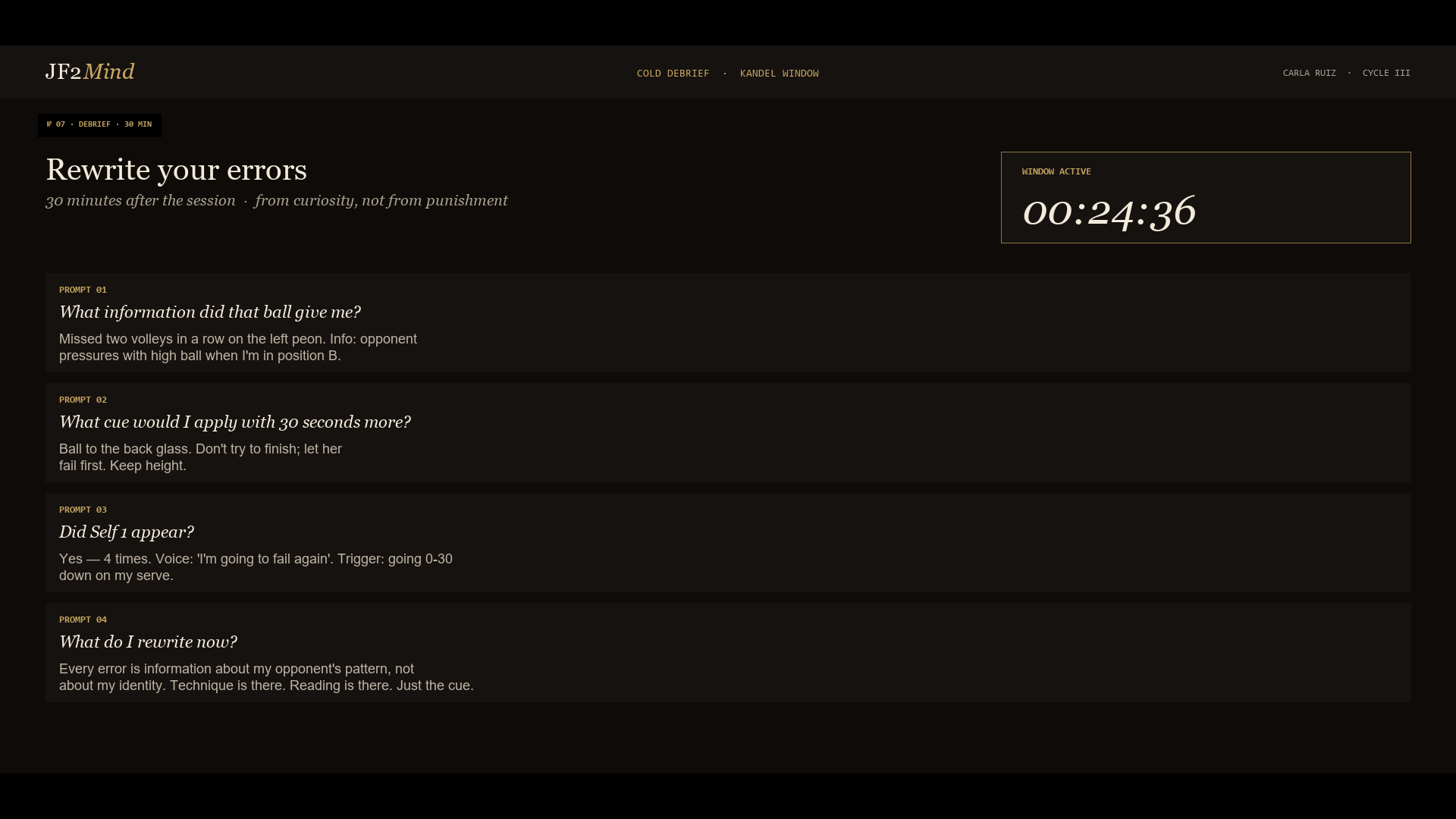
This isn't journaling. It isn't writing how you felt. It's rewriting the error with a four-prompt protocol designed to activate the prefrontal cortex before the amygdala consolidates the pattern.
The measurable result.
Thirty days in, Carla retook the test.
under pressure.
under pressure.
+8 LTSI points. Not "I feel better". Better in a metric that exists, validated by twenty years of scientific literature on learning transfer.
We didn't add a fifth pillar to her game. We simply removed the ceiling on the four she already had: technical, tactical, physical and mental.
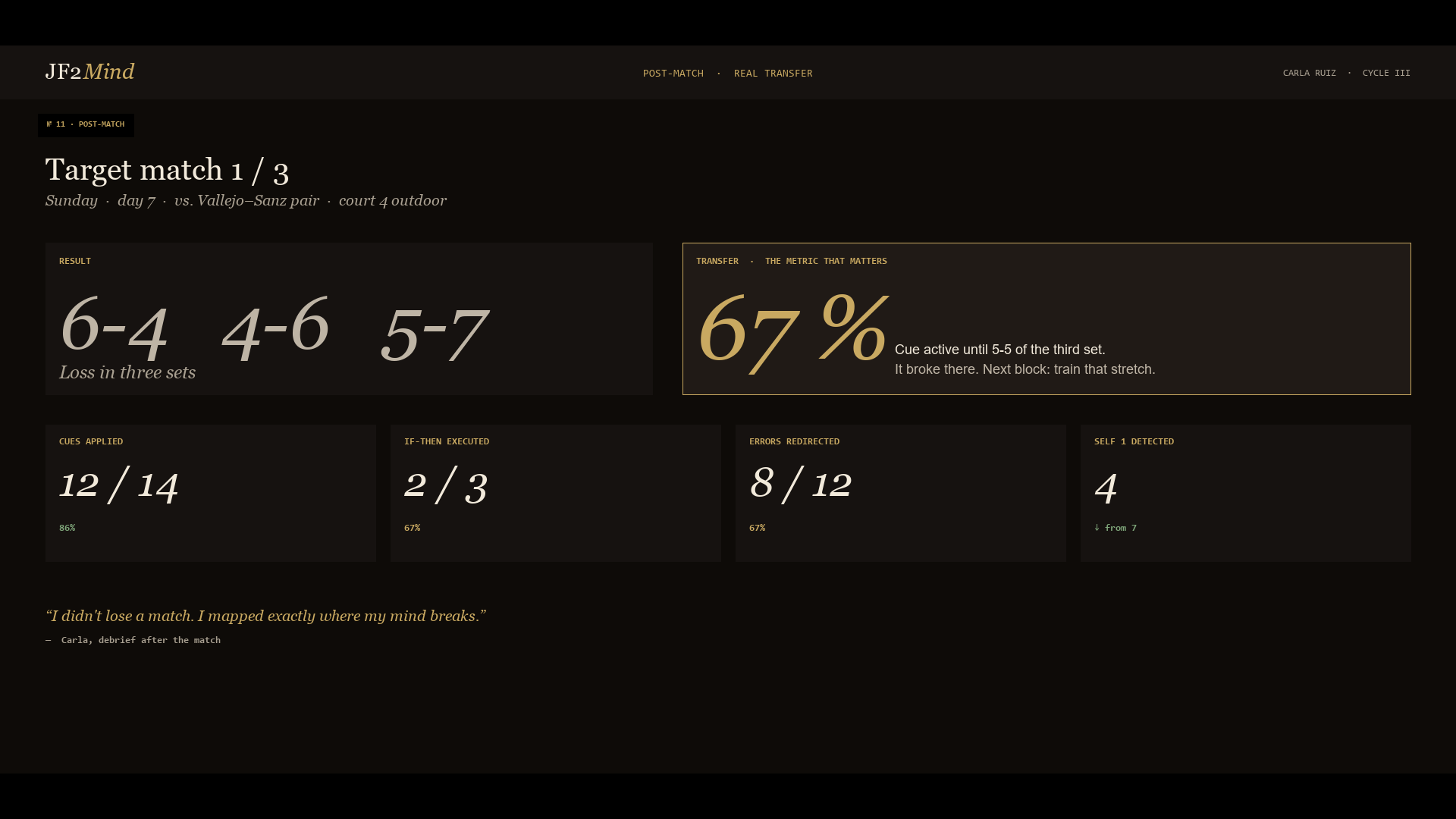
Carla keeps competing. She keeps winning some matches and losing others. The difference, now, is that she knows exactly where her mind breaks, against which type of opponent, in which game, with which cue. And that information, before, didn't exist.